![MS_Master_Horizontal_Reversed (1).png]](https://help.merchantspring.io/hs-fs/hubfs/MerchantSpring%20Logos/MS_Master_Horizontal_Reversed%20(1).png?height=30&name=MS_Master_Horizontal_Reversed%20(1).png)
MerchantSpring API endpoints may use either a synchronous or asynchronous pattern. The main difference is whether the requested data is returned in the immediate response or generated as a separate report.
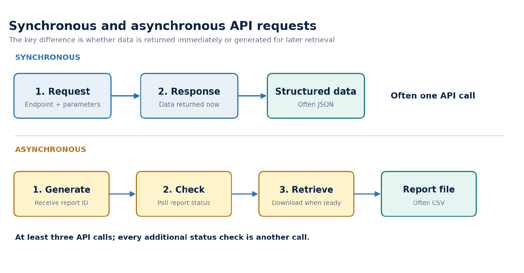
Synchronous and asynchronous request patterns at a glance.
What is a synchronous request?
A synchronous endpoint returns the available data in the same response. These responses are commonly provided as structured data such as JSON and are useful when the result can be returned efficiently.
What is an asynchronous request?
An asynchronous endpoint starts report generation and returns a report ID. Your application then checks the report status and retrieves the output when it is complete. The final report may be provided as a downloadable CSV.
Simple comparison
|
Request type |
Typical process |
Typical output |
|---|---|---|
|
Synchronous |
Request data and receive the response |
JSON or structured response |
|
Asynchronous |
Generate report, check status, then retrieve |
CSV or downloadable report |
Why this matters
Asynchronous reports normally use more API calls because generation, status checks and retrieval are separate requests. Large report files may also require a dedicated processing workflow rather than direct analysis in an AI chat.
Need more help? Contact MerchantSpring Support at support@merchantspring.io.